
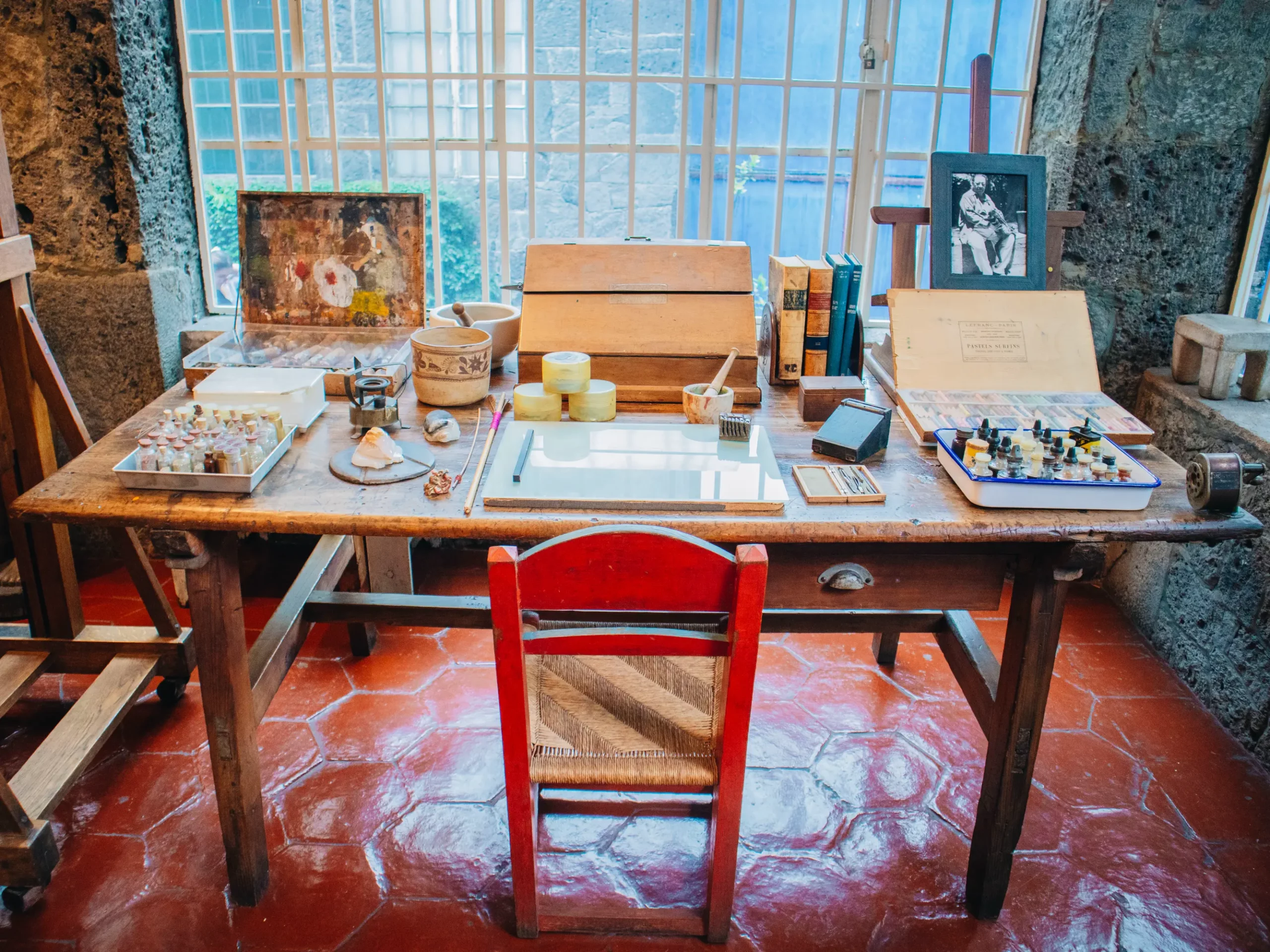
The Casa Azul, or Frida Kahlo Museum, has been a beacon of inspiration and culture in the heart of Coyoacán, Mexico, since its conversion into a museum in 1958. It’s not just a house, but a refuge where the history, art, and life of one of Mexico’s most influential artists, Frida Kahlo, intertwine in a vibrant and captivating narrative.
At first glance, the Casa Azul surprises with its facade of intense blue, a shade known as “bishop’s blue”, which stands out among the streets of Coyoacán. But it is inside where Frida’s true essence unfolds. The rooms, now converted into exhibition halls, are filled with art, personal objects, photographs, and keepsakes that tell the story of Frida Kahlo and her husband Diego Rivera.
Frida was born and died in the Casa Azul. Her parents acquired it shortly before her birth in 1907. In 1925, after suffering an accident that left her with permanent injuries, Frida began painting during her convalescence in the Casa Azul. Many of her most famous works were created here, in the studio she shared with Diego Rivera following their marriage in 1929.
Frida’s life at the Casa Azul was marked by health problems. Surgeries and medical treatments often confined her to her bed, where she painted using a special easel. Her physical struggles were reflected in her intensely personal and emotional self-portraits. The Casa Azul witnessed these periods of pain and introspection, but also moments of joy and creativity.
The Casa Azul was not only a home for Frida and Diego but also an important cultural space. It attracted intellectuals, artists, and politicians from all over the world. Figures like Leon Trotsky, André Breton, and Pablo Neruda frequented the house. The garden hosted extravagant festivities that reflected Frida and Diego’s love for Mexican culture.
In 1939, during Frida and Diego’s brief divorce, she moved to Paris but returned to the Casa Azul the next year when they reconciled. During this time, the house became a refuge for Frida and her art flourished.
In the last years of her life, her health significantly deteriorated. She spent her last days at the Casa Azul and died there on July 13, 1954. After her death, Diego Rivera donated the house to the people of Mexico to convert it into a museum.
Today, the Casa Azul continues to be a vivid testament to Frida Kahlo’s life. It houses an extensive collection of her work, including famous self-portraits such as “Viva la Vida” and “Frida y la Cesárea”. The rooms retain their original decoration, and the garden, filled with Mexican plants and an Aztec pyramid, reflects Frida’s love for her homeland.
Frida Kahlo’s ashes rest at the Casa Azul, in a pre-Columbian urn located in what was once her bedroom. This space, a sanctuary for many, is a reminder of her struggle, her passion, and her unyielding spirit.
The Casa Azul is a journey through the life of Frida Kahlo. Each corner, each object, each piece of art tells a story about her passionate existence. It’s a place where past and present meet, where life and art merge. A place that invites visitors to get to know Frida Kahlo, to understand her art, and to appreciate the rich culture of Mexico.